Food of Kings and Gods
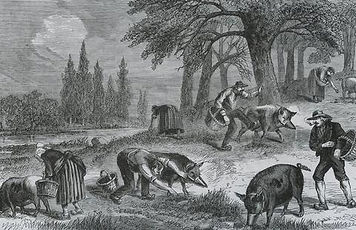
The history of truffles arcs back to the very beginning of civilization, and possibly even before we have had any written record. We know that it was praised by the ancient people of Sumer and known in Egypt. We know that the Greek and Romans were aficionados of this rare mushroom. De re coquinaria, the renowned book of gourmet culinary meals, has several recipes devoted to the truffle - recipes basically unchanged to this day. The origins of the truffle, however, remained a mystery for most of antiquity and well into the 19th century. It was believed, according to accounts by Plutarch, that it was born of lightning, water and earth, where lightening struck an oak tree. The legend, at very least, relates to us that relationship between certain trees, such as the oak, and the truffle was known. The truffle's popularity fell with the decline of the Roman world, it was despised throughout the Middle Ages, and finally, if regained a certain prestige during the Renaissance and the Age of Enlightenment.
The Golden Age - The 19th century
It is however in the 19th century that we really see the emergence of truffle cultivation. Until that point, truffles were mostly foraged and harvested in the wild or in orchards. Advancements in agricultural sciences and mycology led to experiments that allowed for the first successful creation of a commercial truffle plantation in France and Italy. Joseph Talon is credited as the first true truffle planter by planting oaks, in 1808, where he was already harvesting truffles. Another major innovation revolutionized the truffle market: the advent of trains, which allowed for the rapidly deteriorating mushroom to make it to the table of the Paris bourgeoisies instead of being the province of the landed gentry. The 19th century would mark the golden age of the truffle.
20th Century - Crisis and Opportunity
The 20th century, in contrast to the 19th century, was one of stark decline for the truffle industry. The two World Wars saw the death of many of the farmers and planters in France and Italy and the profession found few successors, with a general migration from the countryside to the city. From one thousand tons harvested before the first World War, a mere 40 tons were being harvested in France by the early 90s, before seeing a certain level of stabilization.
The second half of the 20th Century also saw the entrance of new players to the world of Truffles. Turkey, India, China, Spain, Iran and Australia have had relative success in entering the truffle market. It also marked the rise in interest for truffles in North America, particularly the U.S. and Canada, two countries with climates that we wouldn't necessarily associate with truffle cultivation. Nexuses emerged in California and South Carolina, and from California, interest developed further north, where experiments began in Washington and Oregon. This would set the stage for attempts made in British Columbia, which shares the climate of the pacific states. In the east, there was more work to be done. It was not believed that there was any truffle in Quebec or that cultivation was possible until a determined forager demonstrated that there were indigenous truffles growing in the province. Since then, there has been a burgeoning truffle growing industry. In Ontario, meanwhile, a few producers have attempted to use the advantageous growing climate of southern Ontario to their advantage.
The story of the truffle in Canada is still young and it remains to be written.